

Core Overview
The X6PLUS is an upgraded power system for lightweight, efficient agricultural drones. As a comprehensive upgrade of the X6, the kit maintains the recommended takeoff weight of 3.5-5.5kg per axis while achieving an 8% improvement in system efficiency, reaching 7.6-9.3g/W, significantly extending operational endurance. This is achieved through the adoption of FOC vector control, CAN communication, and optimized MFP 24x8.0 propellers. Its unique CAN+PWM dual redundant throttle technology ensures precise and stable "straight-line" flight even in complex electromagnetic environments (even in single-GPS, non-RTK conditions), making it an ideal upgrade choice for entry-level and lightweight agricultural drones pursuing higher operational efficiency and flight reliability.
Core Technology Advantages
Comprehensive Efficiency Upgrade, Fly Longer
FOC Vector Control: Compared to traditional square wave control, it achieves more linear throttle control, 10% efficiency improvement, 10°C lower operating temperature, running more efficiently, quietly, and durably.
Propeller Optimization: Propeller upgraded to MFP 24x8.0, lighter weight (105g), better matching with the power system, collectively contributing to high efficiency.
CAN+PWM Dual Redundant Throttle, Fly Steadier
Dual Signal Assurance: Innovative combination of PWM analog throttle and CAN digital throttle. CAN digital throttle signal is high precision, no attenuation; PWM serves as a reliable backup. Their combination achieves precise control.
Enhanced Anti-interference and Stability: Even in simple modes like single GPS, non-RTK, it effectively resists interference, significantly reducing course deviation, achieving stable "point-to-point" flight, improving operation quality.
Intelligent and Reliable, Maintenance-Free
Powerful Cooling Design: Upgraded motor cooling structure, stronger active cooling capability, performing better than X6 under the same working conditions, ensuring stability during continuous high-power output.
IPX6 Protection and Multiple Protections: ESC fully potted, overall protection level reaches IPX6, fearless of chemicals, water, and dust. Equipped with multiple intelligent protections like throttle signal loss, overcurrent, stall, voltage abnormality, safeguarding flight safety.
Data Communication Upgrade, Future-Ready
Default CAN Communication: Can transmit the full set of power system operating data (throttle, RPM, voltage, current, temperature, etc.) to the flight controller in real-time, achieving real-time status monitoring.
Supports Firmware Remote Upgrade: ESC firmware can be upgraded online via Hobbywing DATALINK data box or through the flight controller, continuously obtaining official performance optimizations and feature updates.
Good Compatibility: Hobbywing CAN protocol has been successfully tested and adapted with multiple mainstream flight controller manufacturers, and provides official protocol support for open-source flight controllers (e.g., ArduPilot), facilitating integration.
Usage Recommendations
- Accurate Load Matching: This kit is optimized for a takeoff weight of 3.5-5.5kg per axis (e.g., 4-axis aircraft total 14-22kg). Strictly control the weight within this efficient range to achieve optimal endurance.
- Priority Use of CAN Connection: To obtain extremely stable control performance and rich data feedback, it is strongly recommended to use CAN bus to connect to the flight controller. Fully utilize the anti-interference advantage of its dual-throttle design to improve operational stability in complex environments.
- Utilize Data Tools for Maintenance: Configure the Hobbywing DATALINK data box, which can be used for firmware upgrades, and more importantly, can read fault storage in case of abnormalities, achieving precise and efficient troubleshooting, changing passive maintenance to active prevention.
- Focus on Daily Simple Maintenance: Utilize its IPX6 protection feature; rinse the body with clean water after operation. Regularly check propellers for damage and ensure connectors are tight.
Product Parameters
Basic Specifications
| Category | Parameter Item | Detailed Specification |
|---|---|---|
| Basic Parameters | Product Name | X6 Plus |
| Maximum Thrust | 11.8kg/axis (46V, sea level) | |
| Single Axis Recommended Takeoff Weight | 3.5-5.5kg/axis (46V, sea level) | |
| Recommended Battery | 12-14S (LiPo) | |
| Operating Environment Temperature | -20 ~ 50 ℃ | |
| Power System Weight (with propeller) | 790g | |
| Protection Level | IPX6 | |
| Rated Input Power | 700W | |
| Rated Output Power | 580W | |
| Motor | KV Value | 150 rpm/V |
| Stator Size | 62 * 18mm | |
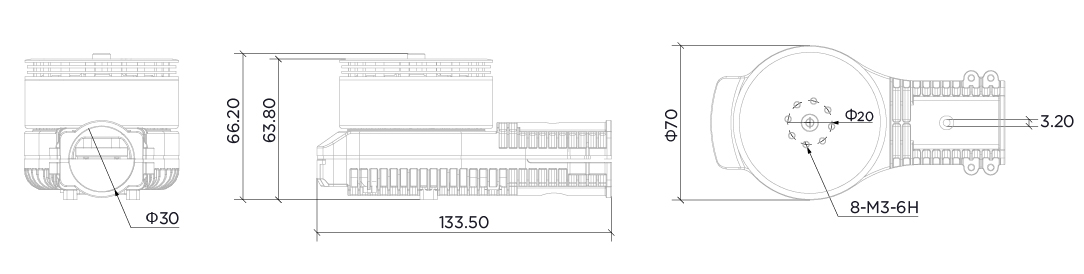
| Applicable Carbon Tube Outer Diameter | 30mm | |
| Bearings | Imported Waterproof Bearings | |
| ESC | Supported Battery | 12-14S (LiPo) |
| PWM Input Signal Level | 3.3V/5V | |
| Compatible Signal Frequency | 50-500Hz | |
| Working Pulse Width | 1050-1950us (Fixed throttle, does not support calibration) | |
| Maximum Allowable Voltage | 61V | |
| Maximum Allowable Current (Brief Continuous) | 80A (Non-enclosed environment temperature ≤60℃) | |
| BEC | None | |
| Propeller | Diameter * Pitch | MFP 24x8.0 |
| Weight | 105g |
Test Data Table
Test Conditions: Operating voltage 46V (12S LiPo), Propeller MFP 24x8.0. The above data was measured by Hobbywing laboratory at room temperature 25℃, sea level altitude, by varying throttle input.
| Throttle (%) | Thrust (g) | Current (A) | Input Power (W) | RPM | Efficiency (g/W) | Torque (N·m) | Output Power (W) | Motor Temp. (℃) |
|---|---|---|---|---|---|---|---|---|
| 35% | 1,499 | 2.4 | 112.9 | 1,960 | 13.2 | 0.49 | 88.1 | |
| 37% | 2,001 | 3.6 | 168.6 | 2,254 | 11.9 | 0.59 | 134.3 | |
| 39% | 2,498 | 4.9 | 228.4 | 2,509 | 10.9 | 0.72 | 184.6 | |
| 42% | 2,498 | 4.9 | 228.4 | 2,509 | 10.9 | 0.72 | 185.9 | |
| 45% | 2,997 | 6.3 | 293.3 | 2,740 | 10.2 | 0.81 | 240.0 | |
| 48% | 3,500 | 8.0 | 371.3 | 2,964 | 9.4 | 0.92 | 305.0 | |
| 51% | 4,001 | 9.7 | 449.0 | 3,158 | 8.9 | 1.02 | 370.3 | |
| 54% | 4,998 | 13.5 | 623.5 | 3,528 | 8.0 | 1.15 | 515.8 | |
| 57% | 5,500 | 15.6 | 723.1 | 3,705 | 7.6 | 1.25 | 599.4 | |
| 60% | 6,003 | 17.6 | 815.1 | 3,870 | 7.3 | 1.38 | 676.6 | |
| 63% | 6,500 | 19.9 | 919.7 | 4,017 | 7.0 | 1.46 | 763.9 | / |
| 66% | 7,005 | 22.1 | 1,021.9 | 4,163 | 6.8 | 1.55 | 848.3 | |
| 69% | 7,504 | 24.9 | 1,150.9 | 4,308 | 6.5 | 1.72 | 953.9 | |
| 72% | 7,999 | 27.4 | 1,267.4 | 4,460 | 6.3 | 1.82 | 1,047.9 | |
| 75% | 8,999 | 32.9 | 1,522.9 | 4,731 | 5.9 | 2.10 | 1,255.4 | |
| 78% | 9,505 | 36.1 | 1,671.1 | 4,866 | 5.7 | 2.28 | 1,372.8 | |
| 81% | 10,000 | 38.6 | 1,787.8 | 4,960 | 5.6 | 2.34 | 1,462.2 | |
| 84% | 10,503 | 42.6 | 1,970.1 | 5,113 | 5.3 | 2.49 | 1,606.1 | |
| 87% | 10,994 | 45.5 | 2,104.5 | 5,221 | 5.2 | 2.64 | 1,709.4 | |
| 90% | 11,494 | 48.8 | 2,258.3 | 5,339 | 5.1 | 2.77 | 1,828.2 | |
| 100% | 11,852 | 51.8 | 2,392.1 | 5,439 | 4.9 | 3.25 | 1,853.1 |
Frequently Asked Questions (FAQ)
Q: What specific upgrades does the X6PLUS have compared to the X6?
A: Mainly four major upgrades: 1) Communication: Serial port upgraded to CAN communication, supporting dual redundant throttle; 2) Propeller: 2388 propeller upgraded to MFP 24x8.0 efficient propeller; 3) Performance: System efficiency improved by 8%, more power-saving; 4) Intelligence: Added fault storage function, enhanced cooling structure. This is a comprehensive upgrade focusing on efficiency, stability, and maintainability.
Q: How exactly do the CAN and PWM dual throttles work? What are the practical benefits for my flight?
A: The system defaults to using the CAN digital throttle for high-precision, anti-interference control. The PWM interface serves as a physical backup channel. Its greatest benefit is significantly improving flight stability in strong electromagnetic interference environments (e.g., near high-voltage lines, large agricultural machinery operation areas), effectively reducing course jitter or deviation due to signal interference. Even without RTK high-precision positioning, it can achieve more "fixed" straight-line flight, ensuring spraying effectiveness.
Q: For the "supports fault storage" function, what do I need to purchase additionally to use it?
A: You need to use the Hobbywing DATALINK data box (requires separate purchase) connected to the ESC, then you can read detailed fault logs on the computer. This is crucial for troubleshooting non-intuitive faults (such as intermittent signal issues, occasional overcurrent), helping you or maintenance personnel quickly locate the root cause, reducing misjudgment and downtime.
Q: Does my flight controller support the CAN protocol of this kit?
A: Hobbywing CAN protocol has been adapted with multiple mainstream flight controller manufacturers. It is recommended to first consult your flight controller manufacturer. If you are using an open-source flight controller (e.g., ArduPilot), you can refer to the official open-source protocol documentation provided by Hobbywing for configuration. The latest list of compatible flight controllers can also be obtained on the product support page or by contacting Hobbywing technical support.
Q: The kit's parameters state "Fixed throttle, does not support calibration." What is the impact?
A: This means the throttle range (minimum and maximum points) has been precisely set and fixed at the factory; users do not need and cannot perform calibration. This avoids flight risks caused by improper user calibration operations, simplifying the debugging process. You only need to ensure the PWM signal output from the flight controller is standard (pulse width 1100-1950μs), and the kit will automatically recognize and work properly.